
Keyword Research for Local Businesses: A Step-by-Step Process (2026 Guide)
Imagine two coffee shops on the same street. One shows up first when people search for “coffee shop near me.” The other is nowhere to be found. Same quality coffee. Same friendly staff. But one gets new customers every day, and the other struggles to fill tables.
The difference is local keyword research.
This isn’t a small trend. In early 2026, “near me” searches passed 200 million per month, and Semrush data shows “near me” keyword variations alone bring in a monthly search volume of 7.1 million. Even more telling: a 2026 Search Engine Land benchmark found that 82% of “near me” searches on mobile end in a store visit, and 31% end in a completed purchase. These aren’t window shoppers. These are people ready to spend money, right now, near you.
If you run a local business, your customers are already searching for you. The question is: are you using the words they’re typing? Most small business owners guess at keywords or skip this step entirely, and that guess costs real customers.
In this guide, you’ll get a clear, step-by-step process for keyword research for local businesses, plus a list of high-value long-tail keyword patterns you can start using today.
What Is Local Keyword Research and Why Does It Matter?
Local keyword research is the process of finding the exact words and phrases people in your area type into Google when they want a product or service like yours.
For example, a bakery in Austin might target phrases like:
“birthday cakes in Austin” “best bakery near me” “custom cupcakes Austin TX”
These are local SEO keywords. They combine what someone wants with where they want it.
Why This Matters for Your Business
It brings in ready-to-buy customers. “Near me” searches carry a conversion rate that outperforms nearly every other digital marketing channel for small businesses.
It beats big competitors. You can’t outrank Amazon for “shoes.” But you can outrank them for “running shoe store in Denver.”
It’s how most people already search. About 46% of all Google searches carry local intent, and 76% of those searches lead to a store visit within 24 hours.
It builds trust fast. A complete Google Business Profile makes customers 2.7 times more likely to trust a business, and showing up in local results signals that trust before they even click.
If you skip local keyword research, you’re guessing. And in 2026, guessing is expensive, especially with more competitors finally waking up to local SEO.
Step-by-Step Framework for Local Keyword Research
Step 1: Brainstorm a Seed List
Start simple. Write down every product, service, and topic related to your business. Think like your customer, not like the business owner.
Ask yourself:
What do I sell or offer? What problems do I solve? What would my neighbor type into Google to find me?
Example: A local dentist might brainstorm: “teeth cleaning,” “dental implants,” “kids dentist,” “emergency tooth pain.”
Step 2: Add Location Modifiers
Combine your seed list with location terms. There are three common patterns:
City or neighborhood name: “yoga studio Brooklyn” “Near me” phrases: “yoga studio near me” Landmark or area names: “yoga studio downtown”
Don’t stop at your city. Think about neighborhoods, suburbs, and nearby towns your real customers live in.
Step 3: Use Keyword Research Tools
Your brainstorm gives you a starting point. Tools show you what people are actually typing, along with search volume and competition data. (Full tool list below.)
Look for:
Monthly search volume Keyword difficulty Related and “People Also Ask” questions Long-tail variations with lower competition
Step 4: Study Your Competitors
Your competitors have already done some of the work for you.
Search your main keywords and see who ranks in the top results and the Map Pack. Visit their websites. What service pages do they have, and what words do they use? Check their Google Business Profile categories and descriptions.
Example: If three top-ranked hair salons all target “balayage specialist [city name],” that’s a strong signal this keyword has real demand.
Step 5: Understand Search Intent
Not all keywords mean the same thing. Sorting by intent helps you build the right content for each one, and it’s key for featured snippet optimization, since Google favors content that directly answers the searcher’s intent.
Informational intent: The person wants to learn something. Example: “how much does teeth whitening cost” Commercial intent: The person is comparing options. Example: “best teeth whitening dentist near me” Transactional intent: The person is ready to book or buy. Example: “book teeth whitening appointment [city]”
Blog posts work best for informational searches. Service pages and landing pages work best for commercial and transactional searches.
Step 6: Group Keywords into Clusters
Group similar keywords together instead of creating one page per keyword. This is called keyword clustering, and it helps you build fewer, stronger pages instead of many thin, competing ones.
Example for a landscaping business:
Cluster 1: “lawn mowing service,” “grass cutting near me,” “weekly lawn care” Cluster 2: “tree trimming service,” “tree pruning cost,” “tree removal near me”
Step 7: Prioritize with Long-Tail Keywords
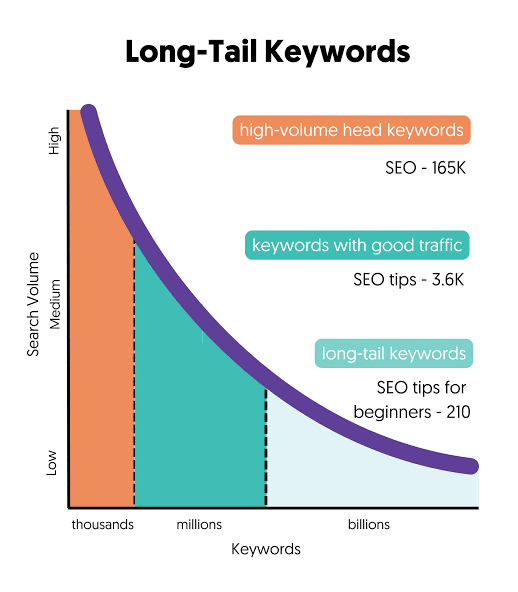
This is where most local businesses miss easy wins. Long-tail keywords are longer, more specific phrases with lower search volume individually, but they add up to the majority of total search traffic, and they convert far better because the searcher already knows what they want.
Here are high-value local long-tail keyword patterns you can adapt to your business and city:
“[service] near me open now.” Example: “emergency plumber near me open now.” Transactional “best [service] in [neighborhood].” Example: “best brunch spot in downtown Denver.” Commercial “affordable [service] [city].” Example: “affordable dog groomer Phoenix.” Commercial “[service] with [feature] near me.” Example: “nail salon with walk-ins near me.” Transactional “how much does [service] cost in [city].” Example: “how much does a roof repair cost in Dallas.” Informational “[service] for [specific need].” Example: “moving company for apartment moves.” Commercial “[business type] open on Sunday near me.” Example: “pharmacy open on Sunday near me.” Transactional “same day [service] [city].” Example: “same day AC repair Houston.” Transactional “[service] near [landmark/area].” Example: “coffee shop near downtown train station.” Transactional “top rated [service] in [city].” Example: “top rated divorce lawyer in Chicago.” Commercial
These patterns work because they mirror how people actually talk when they need something urgently or want reassurance before choosing. A generic keyword like “plumber” is nearly impossible for a small business to rank for. “24-hour emergency plumber near me open now” is realistic, and far more likely to convert.
Step 8: Prioritize Your Full Keyword List
Rank every keyword using three factors:
Search volume: Is anyone actually searching this? Competition: Can you realistically rank for it now? Business value: Will this keyword bring in customers who are likely to buy?
Start with long-tail, lower-competition keywords that still carry strong business value. Build toward broader terms as your site gains authority.
Step 9: Map Keywords to Pages
Assign each keyword cluster to a specific page:
Homepage: Broad brand and service terms Service pages: Specific service + location keywords Blog posts: Informational, question-based, “how much/how to” keywords Location pages: City or neighborhood-specific pages (if you serve multiple areas)
Best Tools for Local Keyword Research
Free Tools
Google Search: Type your keyword and check autocomplete and “People Also Ask.” Google Business Profile Insights: Shows the exact search terms people used to find your listing. Google Keyword Planner: Free with a Google Ads account; gives search volume ranges and location filtering. Google Trends: Shows whether interest in a keyword is rising or falling. AnswerThePublic: Surfaces common questions people ask around a topic. Keyword.io: Free long-tail suggestions pulled from Google, Bing, and other search engines.
Paid Tools
Ahrefs: Strong for competitor keyword analysis, difficulty scores, and uncovering long-tail variations through its Parent Topic feature. SEMrush: All-in-one tool with a Keyword Magic Tool covering over 26 billion keywords, plus Position Tracking built for local SEO. Mangools (KWFinder): Beginner-friendly, with location-specific long-tail keyword data across 65,000+ locations. BrightLocal: Built specifically for local SEO, including rank tracking by city and neighborhood.
Tip for beginners: Start with free tools first. Once you know which keywords matter, invest in a paid tool to scale your research and track rankings.
Real-World Examples
Example 1: A Family-Owned Pizza Shop Instead of targeting only “pizza,” the shop targets “best thin crust pizza in [neighborhood]” and “pizza delivery near [zip code].” Less competition, exact match to nearby customer intent.
Example 2: A Local HVAC Company The company builds separate service pages for “AC repair,” “furnace installation,” and “same day AC repair [city],” each combined with their service area. This captures many specific searches instead of competing for one broad, crowded term.
Example 3: A Boutique Fitness Studio Using Google Business Profile Insights, the studio notices many people search “postnatal fitness classes near me.” They build a dedicated page and blog content around it, capturing a specific, underserved audience with almost no local competition.
Common Mistakes to Avoid
Only targeting broad keywords. “Restaurant” is nearly impossible to rank for. “Best brunch restaurant in [city]” is realistic. Ignoring search intent. Writing a blog post when the customer wants to book an appointment loses the sale. Skipping long-tail keywords. These convert at a much higher rate than short, generic terms because the searcher is closer to making a decision. Forgetting neighborhood-level keywords. Not everyone searches by city name alone. Keyword stuffing. Repeating a keyword unnaturally hurts readability and can hurt rankings. Ignoring reviews as a ranking signal. Review signals account for 16% of local pack ranking weight, so keyword research alone isn’t enough. Pair it with a review strategy. Not updating keywords over time. Search habits shift. Review your keyword list every few months.
Actionable Tips for Beginners
Start with 10–15 core keywords. Don’t try to do everything at once. Use your own customers’ words. Check reviews and past inquiries for the phrases they actually use. Claim and fully optimize your Google Business Profile before anything else; Google Business Profile signals have the biggest impact on local pack rankings. Build one dedicated page per keyword cluster, not per single keyword. Prioritize long-tail, transactional keywords first. They’re easier to rank for and convert faster. Track your rankings monthly so you know what’s working.
Frequently Asked Questions
What is local keyword research? Local keyword research is finding the specific words and phrases people in your area use to search for products or services like yours, so you can target them in your website content and Google Business Profile.
Why are long-tail keywords important for local SEO? Long-tail keywords have lower search volume individually but higher conversion rates, since the searcher is more specific about what they want and closer to making a decision.
How often should I update my local keyword list? Review and refresh your keyword list every three to six months, since search behavior and local competition change over time.
Final Thoughts
Local keyword research isn’t a one-time task. It’s an ongoing process that puts your business in front of nearby customers exactly when they’re ready to buy. Follow the steps above, focus on long-tail keywords first, and stay consistent. You’ll start seeing real results in traffic, calls, and foot traffic.
Need help putting this into action?
At The D Lab, we specialize in local SEO strategies that bring real customers to your door. From in-depth keyword research to full website and Google Business Profile optimization, our team knows what it takes to help local businesses rank and grow.
Contact The D Lab today (https://the-d-lab.com) for a free consultation and start turning local searches into loyal customers.
